

Back in June, I argued that the grain industry has automated the choreography of grain (the identifying, weighing, probing, routing, ticketing and loadout) far more thoroughly than the judgment around it: what the grain is, what it is worth, and what should happen to it next. I promised to follow that judgment to the place where it turns into money, the discount. Summer intervened, and this harvest is making much of the argument for me.
The second half of September was historically wet across the Midwest. As of October 4, USDA’s crop progress report had corn 23% harvested against a five-year average of 27%, and Iowa’s soybeans just 5% harvested against 38%. When the weather breaks, the grain arrives all at once, and in mixed condition. University of Minnesota Extension is warning of sprouted kernels on corn ears, of discolored seed coats in some soybean varieties, and of purple seed stain, which “can lead to significant discounts at the elevator due to its obvious visual characteristic.”
In Ohio, one agronomist reports signs of Gibberella ear mold in roughly 30 to 40% of the fields he has inspected. All of this is landing on a system fuller than anyone expected. USDA counted 2.1 billion bushels of old-crop corn on September 1, 35% more than a year earlier and above the top of the pre-report estimates, ahead of a 15.8-billion-bushel corn crop and a record soybean crop. Nor is the weather finished: the Wall Street Journal reports that El Niño has yet to peak, bringing more heat and crop damage, according to the UN. A wet, compressed, quality-stressed harvest pouring into a full system is the kind of season in which the discount decides more than the bid.
The price of the line
Basis is the local cash price minus the futures price, shaped, as CME Group explains, by local freight, handling, storage, quality, supply and demand. At harvest, local supply swamps local demand and basis weakens. It has done so on cue: corn basis is down as much as 25 cents a bushel since early September and soybean basis as much as 43 cents, with southeast Iowa corn at the lowest level on record for this time of year. But a better basis is useless if the farmer cannot afford to wait in the wrong line. As AgFunderNews’ profile of GrainFlow, a startup piloting AI truck scheduling at elevators this harvest, puts it: “Every truck that waits an extra hour in the morning is a truck that can’t make a second trip that afternoon.” At harvest, time is part of the price. And with December corn futures more than a dollar above last year’s level, every point of moisture shrink and every damage discount now costs more in absolute dollars as well. The farmer’s real question is never just “who has the best bid?” It is “what do I have, what condition is it in, where should it go, and what will it be worth after the line, the discount, the drying and the freight?”
The grader at the table
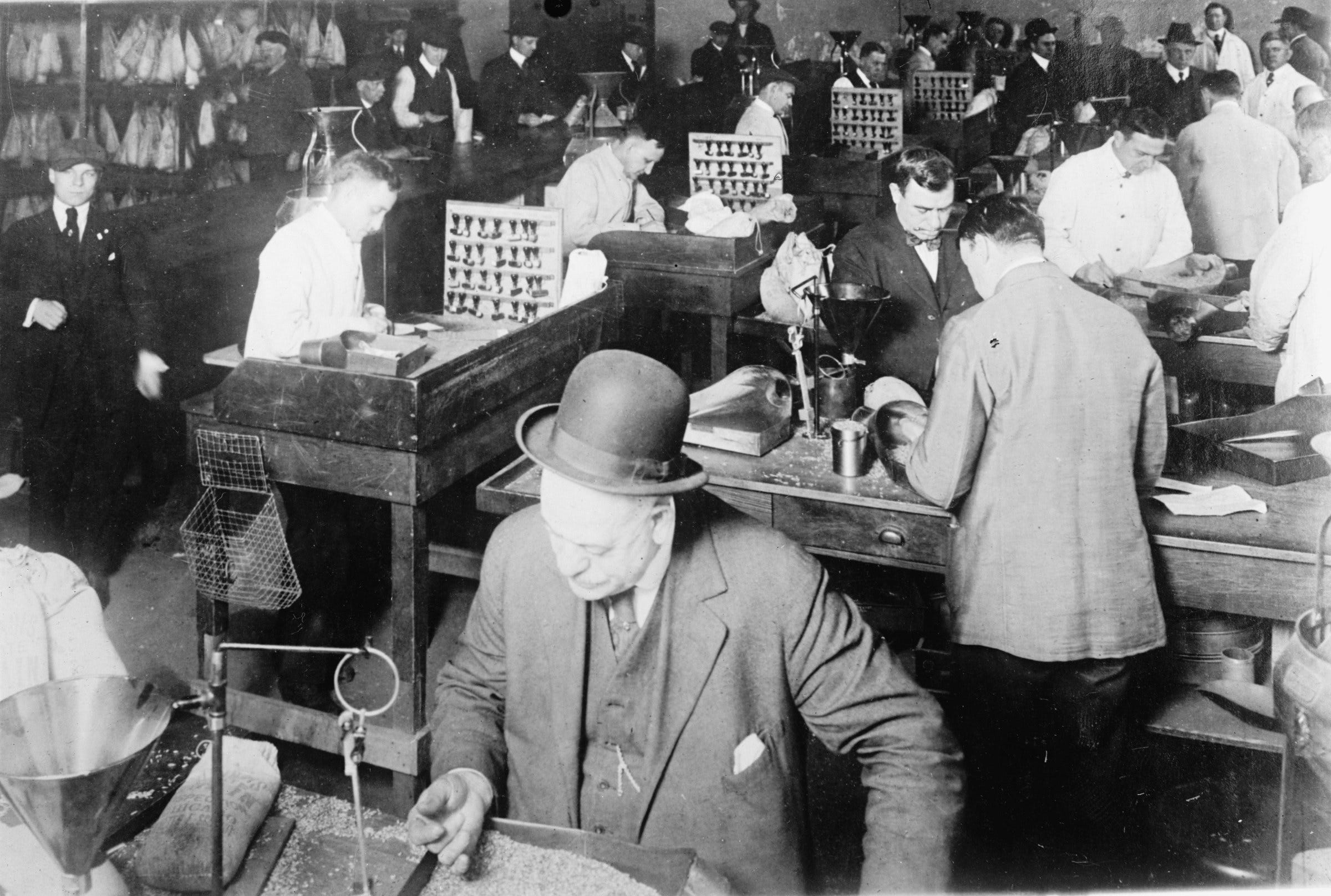
That question meets its answer at the probe. In the United States, grain sold into the domestic market is generally not required to receive official, independent inspection. That obligation attaches mainly at export, as USDA’s Federal Grain Inspection Service and its export elevator overview make clear. At the country elevator, the buyer measures the grain on receipt and assigns the grade. Published discount schedules, such as Didion’s or AGRIServices of Brunswick’s, put a price on moisture shrink, test weight, damage, foreign material, sour or musty odor, infestation and mycotoxins, with rejection limits for the worst of them.
A couple of points of moisture, a light test weight, a musty note or a toxin reading over threshold can re-price a load in seconds, or send it home. None of this requires anyone to cheat. The asymmetry is structural rather than moral. When the party paying for the grain is also the party grading it, the seller will read every borderline call as a call against them, whether it was or not. Grades are also contestable. In Canada’s more formalized system, one grower told the Western Producer that samples sent for independent regrading came back “dramatically in our favor.” Less often appreciated is that the elevator has to live with its grade too. It pays on its own assessment and then sells under someone else’s: an export inspector’s, an ethanol plant’s vomitoxin limit, a processor’s specification. Accept a moldy load into a clean bin and the elevator owns the problem for months. Discount a good load too hard and the hauler takes next year’s bushels down the road. An error in either direction lands, eventually, on the elevator’s own P&L.
The relief valve
Why has this arrangement been tolerable for so long? Because a person sat in the chair. A good grain manager could re-probe a questionable load, round a borderline moisture reading, let a little dockage slide for a hauler who shows up every year, or simply decide to “work with you” in a miserable harvest. It was informal and asymmetric, and it cut both ways: plenty of farmers were docked by a tired person at midnight rather than helped by one. But it served as the farmer’s recourse and, just as importantly, as the elevator’s loyalty program. Grain-marketing advisers still coach growers to negotiate discount terms before harvest, because the discount has always been something to discuss, not a law of nature. The formal alternatives are heavy by comparison: most US grain contracts send disputes to binding NGFA arbitration, a respected institution but one wholly out of proportion to a single docked semi. Even where a neutral regrade is cheap, grower-association guidance acknowledges that many farmers take the grade rather than risk the relationship with an elevator they will sell to again next week. The system runs on soft power and long-term loyalty, not on formal rights.
Taking the human out of the chair
That chair is now being automated in earnest. In Part 1, the hardest step in lights-out receiving was the probe. But grading itself is joining the automated lane. RealmFive’s FlowGrade won a 2026 ASABE AE50 award as an in-line system that folds automated probing, sample handling, grading and data capture into scale operations, explicitly to enable lights-out grain receiving.
Automated grading is sold as more objective and more consistent, and it is both. That is precisely where the risk lies, because consistency is indifferent to whose interest it serves. A machine applies the discount schedule perfectly and tirelessly; it does not re-probe on a hunch, round down, waive, or weigh twenty years of deliveries. The discretion that used to buy loyalty evaporates, while the structural tension of buyer grading seller survives intact, now running at machine speed. An automated “no” is also uniquely hard to argue with: there is nobody in the lane to appeal to, and “the system says so” has always been the most effective way to end a conversation. A discount you can argue with is a negotiation. A discount you cannot argue with feels like a tax, and people route around taxes: to the elevator down the road, to the ethanol plant, or back into their own bins. In Ohio, the harvest outlook already expects that growers with on-farm storage will keep their bins full and move as little grain to town as possible this fall. An elevator that greets them with an unexplained machine verdict gives them one more reason to.
Recourse as a competitive weapon
The answer is not nostalgia for the person in the scale house. It is to make the machine more accountable than the person it replaces, and to treat that accountability as something the elevator sells rather than a concession it makes. In practice, a provable grade would look something like this:
A retained sample, sealed and tied to the ticket, that a neutral party can re-test.
An image of the sample on the farmer’s phone before the truck leaves the scale. This year’s worst defects, from purple seed stain to discolored seed coats, are visual, and a photograph settles more arguments than a phone call.
Calibration records for moisture meters and analyzers that an outside auditor can inspect.
Discount logic the farmer can read rather than infer, applied identically to every load.
An appeal path measured in days and dollars, not in lawyers and arbitration hearings.
None of this is exotic. Ontario’s grain-farmer guidance already describes retained samples, farmer access to grade, dockage, moisture and condition results, and third-party review when disputes arise. What automation changes is the cost. A machine can produce this evidence for every load at nearly zero marginal cost, which a human grader at midnight never could. In a harvest like this one, with long lines and patchy quality, the elevator that can prove its grade in thirty seconds will win the line, and keep winning it. Recourse is not a gift to the seller. It is the operating license for the unmanned lane.
Knowing what is in the line before it reaches the pit
The next step begins before the truck leaves the farm. Today, the grade is a snapshot taken at the most hurried moment in the grain’s life. Yet much of what determines that grade happened earlier: how wet the grain came off the field, how quickly it was dried, whether it sat warm in a bin or a trailer, whether a hot spot was cooled in time. If a record of that condition traveled with the load, both sides would gain. The farmer could show that the grain left the farm in the condition claimed. The elevator would know which trucks carry 20% corn before they queue for the dryer, which loads deserve a second probe, and which can go straight to the shipping bin. The argument over the discount would move from the scale house, where everyone is tired and in a hurry, to the evidence, where it belongs.
A theory of the grain
Nor does the judgment end at the pit. As I wrote in September, grain in storage is not inert inventory but a slow biological and thermodynamic system: moisture migrates, temperature gradients form, insects and molds respire. This year the advice is unusually blunt. Minnesota’s agronomists call for “timely harvest and quick drying” of corn, and the Ohio agronomist quoted earlier wants mold-prone corn dried below 15% moisture before it is stored. None of this is visible on a scale ticket. All of it decides what the grain will be worth next spring, and whether the discount applied in October was even the right one.
This is why “AI in grain” cannot mean only automating paperwork or draping a chatbot over a portal. A truly lights-out facility needs a trusted state of the commodity, not just of the machinery. It needs models that recommend safe actions (aerate or wait, blend or segregate, fumigate or monitor, ship or hold, accept or reject) and evidence of what happened after each one. That theory of the grain will come from joining load records, samples, sensor data, weather, treatments and buyer specifications, and then closing the loop. A system cannot learn judgment if it never sees the outcome of its own decisions.
The grain industry should be proud of how far handling automation has come. It has made elevators faster, safer and more available to farmers in the most stressful weeks of the year. But the next frontier is not merely an unmanned elevator. It is a post-harvest system that knows what is happening to the grain while no one is looking, and can prove it to the people on both sides of the scale.
The elevator may be lights-out. The grain is still opaque. The operators who illuminate it first will not only grade better; they will be the ones farmers choose to haul to.
If you run receiving at an elevator, or haul to one, and think the grade should come with its evidence, write me at sotiris at centaur dot ag. I’d be glad to compare notes.